Judges hint at Prop 8 case twists and turns
The effort to undo California's Proposition 8 inched forward Dec. 6 when a three-judge panel of the 9th U.S. Circuit Court of Appeals entertained nearly three hours of oral arguments from the attorneys in the case.
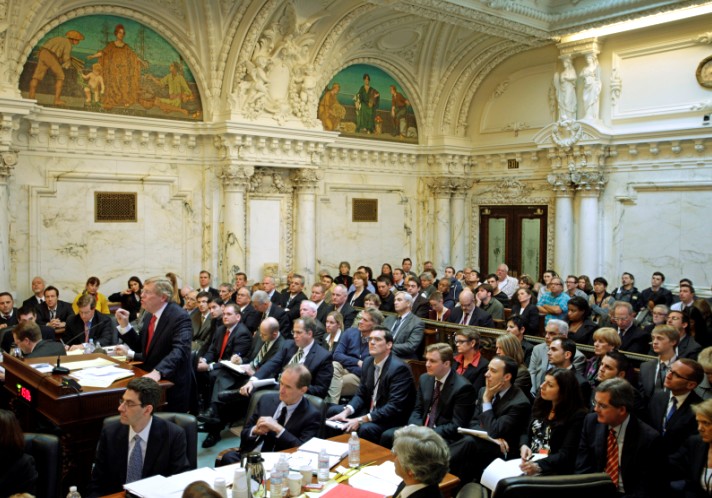 In an ornate courtroom on the third floor of San Francisco's historic James R. Browning U.S. Courthouse, amid murals, stained glass and statues dating to 1905, the attorneys replayed some of their main arguments and the judges offered hints of where the case might go.
The gay side's lawyers, who include famed attorneys Ted Olson and David Boies, sought to defend U.S. District Judge Vaughn Walker's ruling from August that Prop 8 violates the U.S. Constitution's guarantees of equal protection and due process.
 They also argued that the parties who brought the appeal to the 9th Circuit -- the activists who created Prop 8 and the deputy county clerk of Southern California's dusty Imperial County -- have no legal "standing" to have mounted this appeal of Walker's ruling.
Those parties are trying to defend Prop 8 because all the public officials who were sued in the case -- including Gov. Arnold Schwarzenegger and Attorney General (and Gov.-elect) Jerry Brown -- have refused to defend the voter-passed state constitutional amendment that re-banned same-sex marriage in November 2008 after it had been legal for 4 1/2 months and after 18,000 same-sex couples had married.
It is unclear if the court will grant the Prop 8 proponents or Imperial County standing to allow the appeal to move forward. The judges seemed unimpressed by Imperial County's desire to be let into the case. Among other things, they seemed annoyed that the deputy county clerk rather than the actual clerk is pursuing the move.
As to whether the people who put Prop 8 on the ballot should be allowed to step into the shoes of the state government and defend a piece of the state constitution that the state itself refuses to defend, the judges hinted that they might bounce that question off of the California Supreme Court to see how it feels about the idea. If the 9th Circuit does that, it could delay appellate rulings on both the standing issue and the merits of Judge Walker's decision.
On the merits, Olson told the judges that California has unconstitutionally "taken a class of citizens and put them in a separate category."
 California gives same-sex couples all the rights and obligations of marriage under a domestic-partnership law, but prohibits gay couples from marrying. Under another law, gay couples who go get married somewhere else also receive all the California rights of marriage but are prohibited from calling their marriage a marriage in California. Yet other gay couples, who got married in California or somewhere else before Prop 8 passed, are considered to be married in California and are permitted to use the word. It's very messy.
All of this is discriminatory, Olson said. It harms gay Californians. There is no legal rational basis for it. It cannot be "justified," he said.
 "California has built a fence around its gay and lesbian citizens and around the institution of marriage," Olson told the judges. "That is a violation of the equal-protection clause and it's a violation of the due-process clause."
Attorney Charles Cooper for the Prop 8 proponents told the judges that his case in defense of Prop 8 centers on "procreation."
In Cooper's view, it is rational for the state to limit marriage to men and women because the reason marriage exists in the first place is because sex between men and women produces children. The state, he suggested, has a unique interest in human unions that are procreative.
 At the end of the day, court-watchers were talking about three things that piqued their curiosity during the oral arguments:
* Will the case be delayed so the 9th Circuit panel can sound out the California Supreme Court on the question of whether people who put initiatives on the ballot should be able to defend those initiatives when they are struck down by courts? Regardless of whether the judges seek advice from the California Supreme Court, the case cannot proceed if the 9th Circuit decides that neither the Prop 8 proponents nor Imperial County has legal standing to appeal. If they do not, Walker's ruling striking down Prop 8 would come back into force.
* In hearing the appeal of Walker's ruling, will the 9th Circuit rely solely on Walker's expansive trial record, which seems to demolish most of the myths, lies, arguments and opinions that historically have been used to oppress gay and lesbian people? Or will the 9th Circuit look at additional sources of information and seek out other "facts"? The court hinted that it may review more than just the District Court's findings.
* And has the 9th Circuit perhaps hinted that it plans to uphold Walker's decision but in a way that would limit the case's impact to California, the only state that ever let gays get married and then later took that right away from them? The court spent a fair amount of time discussing a 1996 case from Colorado in which the U.S. Supreme Court struck down a state constitutional amendment that deprived gay people of anti-discrimination protections that Colorado governments previously had extended to them.
A "narrow" ruling against Prop 8 by the 9th Circuit could bring same-sex marriage back to California but possibly thwart Olson, Boies and the American Foundation for Equal Rights' desire to take before the U.S. Supreme Court the proposition that same-sex couples have a constitutional right to get married in all states.
Pool photos by AP's Eric Risberg
posted by Wockner at 3:23 AM

