Prop 8 federal case delayed for several more months
A huge new delay was introduced into the federal case against California's Proposition 8 yesterday.
 The California Supreme Court now has decided, unanimously, that it will indeed answer the question and has set up a briefing schedule, to be followed by oral arguments no sooner than September.
The 9th Circuit asked the California Supreme Court if the people who put Prop 8 on the ballot have any legal right, under California law, to be in court arguing to overturn last summer's federal District Court ruling that struck down Prop 8 as a violation of the U.S. Constitution.
Those proponents, ProtectMarriage.com, want to defend Prop 8 because California's governor and attorney general and everyone else who was sued in the federal Prop 8 case have refused to defend the constitutional amendment that, in 2008, re-banned same-sex marriage in the nation's most populous state.
The 9th Circuit decided it couldn't proceed with the case without hearing the California Supreme Court's opinion on ProtectMarriage's state-level right to defend Prop 8, which the 9th Circuit could then take under consideration in deciding whether to grant ProtectMarriage federal "standing" to appeal.
If ProtectMarriage is found to have no standing, then the case has no proper appellants and the 9th Circuit won't hear the appeal. Should that happen, the most likely outcome would be that the District Court ruling that struck down Prop 8 would take effect, and gay couples in California would be able to get married again -- although the standing question itself could end up being appealed by ProtectMarriage to the U.S. Supreme Court.
The question the California Supreme Court will answer, as asked by the 9th Circuit, is: "Whether under Article II, Section 8 of the California Constitution, or otherwise under California law, the official proponents of an initiative measure possess either a particularized interest in the initiative's validity or the authority to assert the State's interest in the initiative's validity, which would enable them to defend the constitutionality of the initiative upon its adoption or appeal a judgment invalidating the initiative, when the public officials charged with that duty refuse to do so."
Shannon Minter, legal director of the National Center for Lesbian Rights, expressed annoyance at the new, lengthy delay in the case.
"For same-sex couples waiting to marry, and for all LGBT Californians waiting to be treated as equal citizens, the knowledge that they must endure further delay is incredibly painful and frustrating," Minter said. "Prop 8 should never have been permitted on the ballot. The rights of a minority should never be put to a popular vote. Prop 8 was a toxic, anti-democratic measure that continues to wreak havoc in the lives of real people and families. The court should move as quickly as possible to resolve this issue. It is clear that California law does not give initiative proponents the power to override elected state officials who have decided not to appeal a federal court decision holding that a challenged state law is unconstitutional. The California Supreme Court should rule accordingly, and the 9th Circuit should affirm Judge Walker's ruling. Prop 8 is blatantly unconstitutional, and it is past time for it to be gone."
Lambda Legal seemed even more annoyed by the day's developments, throwing a lengthy fit from atop its highest horse.
"Because the federal appeals judges said they need clarification, we look forward to a decision by the California Supreme Court confirming that initiative proponents lack legal standing to continue the Perry case," said Marriage Project Director Jennifer Pizer. "They are not law enforcers, and have the same limited rights as everyone else to litigate only when their own rights are at stake, not merely to assert their opinions about others' rights. Initiative proponents also cannot step into the shoes of the attorney general, the governor or other state officials. The reason for this is basic: The governor and attorney general are elected by the people to represent all the people, not just one point of view on one issue, out of countless, competing concerns. Most importantly, state officials swear an oath to uphold the federal and state constitutions, including their abiding promises of equal protection and due process for everyone. Initiative proponents take no such oath, and have no such duties. Empowering initiative proponents with a special, new exception to these rules would be mistaken in any circumstances but the error is especially stark in this case. Prop 8's proponents claim to represent 'the people,' but in fact they only represent some 7 million voters in a state of 38 million residents. Moreover, according to the U.S. census, the tiny group of same-sex-couple residents targeted by Prop 8 is only around 200,000 people, or less than 2 percent of the population. The state high court's previous decision to allow the initiative power to be used in the unprecedented way Prop 8 did -- to strip a terribly vulnerable minority of a fundamental constitutional right -- also stripped the equality guarantees out of the California Constitution. Yet another departure now from bedrock California law to allow proponents an exception from the 'legal standing' rules would invite further, deeply problematic consequences. It would mean proponents could enter every case about an initiative to argue against the state's position. They could refuse ever to compromise about anything concerning the litigation process. And they could object to every settlement plan based on ideology about what the law should be, rather than what it is."
Equality California Executive Director Geoff Kors also was agitated.
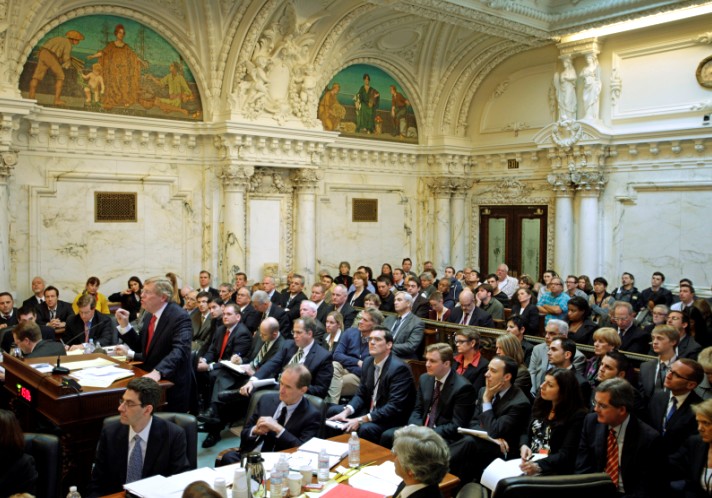
The case is before the 9th U.S. Circuit Court of Appeals, which, after hearing oral arguments (photo) in December, punted off a question to the California Supreme Court.
 The California Supreme Court now has decided, unanimously, that it will indeed answer the question and has set up a briefing schedule, to be followed by oral arguments no sooner than September.
The 9th Circuit asked the California Supreme Court if the people who put Prop 8 on the ballot have any legal right, under California law, to be in court arguing to overturn last summer's federal District Court ruling that struck down Prop 8 as a violation of the U.S. Constitution.
Those proponents, ProtectMarriage.com, want to defend Prop 8 because California's governor and attorney general and everyone else who was sued in the federal Prop 8 case have refused to defend the constitutional amendment that, in 2008, re-banned same-sex marriage in the nation's most populous state.
The 9th Circuit decided it couldn't proceed with the case without hearing the California Supreme Court's opinion on ProtectMarriage's state-level right to defend Prop 8, which the 9th Circuit could then take under consideration in deciding whether to grant ProtectMarriage federal "standing" to appeal.
If ProtectMarriage is found to have no standing, then the case has no proper appellants and the 9th Circuit won't hear the appeal. Should that happen, the most likely outcome would be that the District Court ruling that struck down Prop 8 would take effect, and gay couples in California would be able to get married again -- although the standing question itself could end up being appealed by ProtectMarriage to the U.S. Supreme Court.
The question the California Supreme Court will answer, as asked by the 9th Circuit, is: "Whether under Article II, Section 8 of the California Constitution, or otherwise under California law, the official proponents of an initiative measure possess either a particularized interest in the initiative's validity or the authority to assert the State's interest in the initiative's validity, which would enable them to defend the constitutionality of the initiative upon its adoption or appeal a judgment invalidating the initiative, when the public officials charged with that duty refuse to do so."
Shannon Minter, legal director of the National Center for Lesbian Rights, expressed annoyance at the new, lengthy delay in the case.
"For same-sex couples waiting to marry, and for all LGBT Californians waiting to be treated as equal citizens, the knowledge that they must endure further delay is incredibly painful and frustrating," Minter said. "Prop 8 should never have been permitted on the ballot. The rights of a minority should never be put to a popular vote. Prop 8 was a toxic, anti-democratic measure that continues to wreak havoc in the lives of real people and families. The court should move as quickly as possible to resolve this issue. It is clear that California law does not give initiative proponents the power to override elected state officials who have decided not to appeal a federal court decision holding that a challenged state law is unconstitutional. The California Supreme Court should rule accordingly, and the 9th Circuit should affirm Judge Walker's ruling. Prop 8 is blatantly unconstitutional, and it is past time for it to be gone."
Lambda Legal seemed even more annoyed by the day's developments, throwing a lengthy fit from atop its highest horse.
"Because the federal appeals judges said they need clarification, we look forward to a decision by the California Supreme Court confirming that initiative proponents lack legal standing to continue the Perry case," said Marriage Project Director Jennifer Pizer. "They are not law enforcers, and have the same limited rights as everyone else to litigate only when their own rights are at stake, not merely to assert their opinions about others' rights. Initiative proponents also cannot step into the shoes of the attorney general, the governor or other state officials. The reason for this is basic: The governor and attorney general are elected by the people to represent all the people, not just one point of view on one issue, out of countless, competing concerns. Most importantly, state officials swear an oath to uphold the federal and state constitutions, including their abiding promises of equal protection and due process for everyone. Initiative proponents take no such oath, and have no such duties. Empowering initiative proponents with a special, new exception to these rules would be mistaken in any circumstances but the error is especially stark in this case. Prop 8's proponents claim to represent 'the people,' but in fact they only represent some 7 million voters in a state of 38 million residents. Moreover, according to the U.S. census, the tiny group of same-sex-couple residents targeted by Prop 8 is only around 200,000 people, or less than 2 percent of the population. The state high court's previous decision to allow the initiative power to be used in the unprecedented way Prop 8 did -- to strip a terribly vulnerable minority of a fundamental constitutional right -- also stripped the equality guarantees out of the California Constitution. Yet another departure now from bedrock California law to allow proponents an exception from the 'legal standing' rules would invite further, deeply problematic consequences. It would mean proponents could enter every case about an initiative to argue against the state's position. They could refuse ever to compromise about anything concerning the litigation process. And they could object to every settlement plan based on ideology about what the law should be, rather than what it is."
Equality California Executive Director Geoff Kors also was agitated.
"Every day that Prop 8 remains intact, thousands of same-sex couples and their families are denied fundamental rights and basic protections," he fumed. "We urge the California Supreme Court to reject this attempt by the right wing to strip the attorney general of her duty to reject this assault on the California Constitution. Knowing that they are likely to lose, far right-wing California Sen. Tom Harman has introduced a bill that would compel the attorney general to defend all ballot measures and appeal court decisions striking them down such as what happened with regard to Proposition 8. The bill would also authorize the groups that placed measures on the ballot to defend their measures in court if the attorney general is unable to. We call on all Californians to reject this attempt to take power away from the people's attorney, the elected attorney general, and give it to special interest groups."
Pool photo by AP's Eric Risberg
posted by Wockner at 1:26 AM